
by Samuel Marlow
Having just written about how Forward Unto Dawn sets a technical benchmark for web television, I thought I'd take the opportunity to review the series that wrapped up this morning.
Unlike other reviews I've written, it is gratifying to be able to embed the series in question:
The five-part series revolves around Cadet Thomas Lasky and his associates at the Corbulo Academy for the sons and daughters of high-ranking officers in the United Nations Space Command. He and the others are being trained for key roles in the war against the "Insurrectionists" - human colonists who seem to was independence from the main government.
The series starts with the now-adult Lasky receiving a message from AI unit Cortana, who is trapped aboard a stricken ship with the Master Chief in hyper-sleep (where they were stranded at the end of Halo 3), but the bulk of the series action takes place in a time before the Covenant War. In that sense, this series could constitute a kind of origin story, and is the most recent in a long line of visually high-quality live action material from the Halo games franchise.
For several years, the Halo team have been making exciting trailers for their games, arguably topped with the ad campaign for Halo: Reach. Forward Unto Dawn goes one step further, however, in that it attempts to tell a (broadly speaking) stand-alone story. Rather than being an advert for a game, Forward Unto Dawn is self-contained enough to be watched as a piece of entertainment in its own right. While people who are not even remotely familiar with the game franchise may lose the impact of the Master Chief's appearance in Part 4, a working knowledge of the back story is not necessary.
This is helped by the fact the story itself is very simple - I might argue too simple for the 85 minute running time. Handled with a bit more pace and energy, I feel like we could have been dashing through the first act of a two-hour story. By that logic, then, the series felt nearly three times longer than it needed to be. Or only twice as long if we assume the Covenant attack represents the start of Act II.
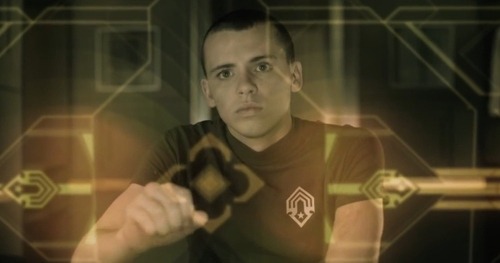
The story that is there stars Tom Green as Cadet Thomas Lasky. While his cohorts are being indoctrinated into a war against Insurrectionists, he is wondering whether they are really as bad as they have been told. This element of doubt and self-reflection, coupled with Lasky's asthma-like side effects from the hyper-sleep, saves the series from feeling as stupidly gung-ho as, say, Starship Troopers. Lasky is presented as a strategist rather than a brawler, which is shown as being curiously at odds with those supposedly training him.
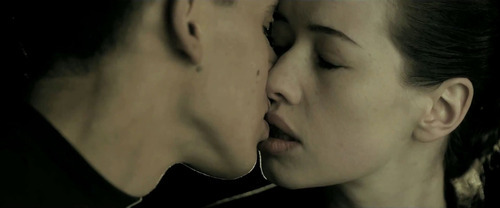
His co-star is Narnia's Anna Popplewell playing a far more zealous student. Narrative necessity rather than character development forces the two of them into a slightly rushed and unconvincing romance, while the roles of stock characters - the computer geek, the jock, the studious book-worm - are filled by the other cadets at the school.
I have to admit, the choice of characters and their relationships felt designed to appeal to a mid-teen market, at times taking on the tone of a teen drama rather than a war film. After Lasky's free-thinking causes his team to lose a bout of Capture the Flag there is even a locker-room "We lost the big game because of you!" moment that was a little tedious and left me wondering who the series' target audience is. It started to feel a bit like Hogwarts with automatic assault rifles.
The acting was ropey in places from the team's secondary characters, though certainly in the acceptable range. Tom Green was far and away the most competent of the faced actors, managing to communicate some real fear and emotion during the invasion, making him endearing, though his character never became realised enough to make him relatable enough for me to have any interest in his survival. I know she is playing a military character, but I still can't tell if Anna Popplewell can act. There were too many pouting-and-frowning-at-the-same-time looks that were identical to the Chronicles of Narnia films. To what extent this is trying to make another nothing character interesting, the fault of the director or the actor is hard to say.

Obviously what everyone was waiting for, though, was the debut of the Master Chief. Played by Daniel Cudmore, whose face you may recognise if you could see it from the third X-Men film (he also was a character in the Twilight films, though I imagine the chances of anyone having seen him in both Twilight and Forward Unto Dawn are slight given their respected target markets), had probably the most important and under-rated role. Wearing a giant suit of armour and full-face helmet robed the actor of even the chin-acting Karl Ubran benefited from in Dredd. However, had the character failed to live up to expectations it is fair say 343 would have had their own insurrection to deal with.
As far as is possible, Cudmore carried off his role admirably. Helped by Tom Green's diminutive stature, Cudmore's Chief towered over the rest of the cast and, fibreglass or not, managed to get the chunky armour moving with the fluidity, grace and purpose that you would expect of a super-soldier. Steve Downes, who supplied the Chief's voice, also hit the fine line between enigmatic and lifeless.

All of which only served to reinforce what I already feel about the on-again-off-again Halo movie - the Master Chief works better as a secondary character. To feature him as the main character would ruin the enigma that makes him interesting.
This restraint was also in evidence in how the aliens were dealt with. The first we see of the Covenant - an elite - is reflected in the visor of a Spartan (also hitherto unseen) in a grainy video recording. When they do attack their ships appear as eerie lights in the sky, the aliens themselves only briefly glimpsed before turning their camouflage one, or partially illuminated silhouettes in the darkness.
Whether motivated by budget or an attempt to ground the series in a kind of reality, this coupled with the generally light-touch special effects kept the series visually interesting yet believable.

However, when all's said and done, I couldn't escape the feeling that this was a feature-length promo for their new game. The series ends with what I expect to be the start of Halo 4. I don't blame the series for this and as an hour and a half long advert is probably the only way it could have secured its up to $10m budget, but I do feel this reflected badly in the script.
A tease is fine in a trailer, but after five 15 to 20 minute episodes I wanted more in the way of character. Lasky is no different at the end than he was at the start, while the problem of spreading an act's worth of material over a feature-film's length while trying to develop a love story parallel to it caused the story's gears to grind. The love story was going too fast for the pace of the story.
I understand the Master Chief is immutable from a story point of view - like Judge Dredd he cannot change over the course of the story - but, as far as I am aware, Lasky, Silva, Orenski and the others were created for this story alone, and many of the characters we start with don't make it to the end anyway. Yes, this is a space action adventure story, who's target audience (whomever they may be...) may not want a character-story, but the Halo stories seem to be going down that route anyway.
The dramatically overwrought Remember Reach campaign made it feel like we were being encouraged to "reach" for the tissues - here's a young couple expecting a baby, here's a woman leaving her son. While the characters having their heads shaved and sent off into battle in other Reach trailers were similarly traumatic.
While it is undeniably a very high achievement technically, it singularly fails to achieve what zero-budgeted shows have - namely tell and interesting story about interesting people. The series was entertaining and diverting, and the Covenant invasion was exciting, but it didn't leave me with a lasting impression, nor make me want to buy the video game.
Which of these was the series primary objective is open to interpretation.

No comments:
Post a Comment