
I recently saw the second trailer for The Dark Knight Rises, the conclusion to Christopher Nolan’s Batman trilogy, and it got me thinking about my ambivalence after seeing The Dark Knight way back in 2008.
I was overjoyed that the film had been so exciting, and I felt genuinely drained at the end, not to mention the sense of anticipation as to what was to come. I also felt trepidation as I felt the series had played its Ace card with the Joker (you know what I mean!).
Christopher Nolan’s direction of Heath Ledger’s Joker left an indelible mark on many of the people who saw him. It has been the source of a few heated discussions for me. I know a few people who have said, “I hated Heath Ledger’s Joker. He was far too violent. Completely inappropriate for a superhero film.” When I have asked how they felt about Jack Nicholson’s Joker they would say, “Oh, no. He was fine.”
As I go on to point out that Jack Nicholson’s Joker was far more violent and killed far more people than the Ledger Joker did, the discussion invariably takes a more religious turn. Words like “godless” start getting thrown around.
What I have tried to point out is that the difference between the Ledger and Nicholson Jokers is that the Ledger Joker is credible. He is so frightening because he is not too much of a stretch from reality. Nicholson’s Joker, while being a great pantomime villain, was ultimately just that. He has said in interviews that he believes the “badder” you are, the more the kids love it.
The Batman/Joker relationship may be the best hero/opponent relationships ever invented in the comicbook medium. The reason is that truly are a mirror to each other. Despite the darkness of Batman, he is an agent of the status quo. The Joker meanwhile represents randomness, random violence, random death - the idea that you don’t have to be his enemy or get in his way for him to destroy you. He is Death.

As thrilling as this is, the more I watched The Dark Knight on DVD (who would have guessed you can wear a DVD out?), I came to realise the Batman fails to live up to this challenge. Frank Miller has gone on record in saying he believes the Batman is a fascist - a control freak, a man who will not tolerate a difference of opinion. If we look at the early events of Bruce Wayne’s life, the fact that he would become a control freak is not only unsurprising but logical. We have a man who’s parents were taken away from him in an act of sudden random violence. While I think his psychopathic tendencies must predate this event, brought about by a distant workaholic father and largely absent mother (yes, the Thomas Wayne in Batman Begins was far too involved in Bruce’s life), it was this random killing that caused Bruce Wayne to take up his cause.
Several people commented that the Batman’s extreme behaviour in pursuit of the Joker were analogous to the “dirty tactics” of the USA in its War on Terror. To me, the Batman beats up the Joker a little bit but, heavy breathing and gravelly shouting aside, I never thought the Batman would kill or seriously injure the Joker. Evidently, neither did the Joker.
I therefore felt that the Joker should have been so threatening to Batman’s ideology that all his objectivity would fly out the window, and the two of them would descend into a cat and mouse game, tearing up Gotham City as they go in an effort to destroy one another. The Batman sinks to the Joker’s level, and then has to try to climb back up after seeing it is not worth it. This would also have negated the problem that the Batman becomes almost entirely reactive after the destruction of the hospital.
What better villain than the Joker to exploit Batman’s weaknesses? Who better to get under his skin? Who will they cast as Part III’s villain?
Bane?! Are you serious?!

As with many people my age, my idea of Bane is the rubber-muscled bull in a china shop who was one of the cacophony of villains in the car crash that was Batman & Robin. Someone to do Poison Ivy’s heavy lifting. Really? This is your climactic villain?
Either Christopher Nolan has gone mad with power between The Dark Knight and The Dark Knight Rises, or I will have to reassess my interpretation.
Among the many excellent things about Ledger’s Joker, is this is the first time he has been played properly as a Trickster. Those of you who follow this blog over time will come to realise I have a fascination with the Trickster in all his many boundary-transgressing, shape-shifting, gender-swapping guises.
The Trickster seems to have been constant in all mythologies throughout the world, often portrayed as a folk-hero, Robin Hood being a classic example. The fact that the Trickster is consistently inconsistent makes him difficult to write a stand-along story around, however - he doesn't go through an emotional arc or change of character that all modern story-telling is about. As we see him in modern story-telling he appears more as a fulcrum in the hero/opponent relationship. Sometimes beneficial to the hero, other times a threat.
If we apply my own little Trickster Acid Test, we see the Joker is a perfect Trickster:
Transgressor of Boundaries
The first time we meet him properly, he is able to stroll into a heavily guarded meeting of mobsters. He then walks into Bruce Wayne’s high-society fundraiser with similar ease, and is no less at home in either. The Trickster has no domain. His both homeless and at home anywhere.

Shape-Shifter
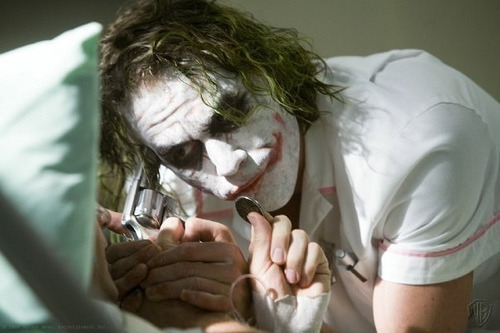
In the opening scenes of the film, the Joker was in disguise as one of the bank robbers. He then transmutes into he “true” form before becoming a police marksman, and a nurse.
Gender-Swapping
The Joker is definitely a man, but Ledger’s Joker was played with a slightly effeminate quality that prompted some bloggers to ask if he was being portrayed as a homosexual. I don’t think he was, but he does become a female nurse, and spend 10 chillingly humorous minutes of the film tottering around in a nurses uniform.
Ambiguous Assistance
Finally, and most crucially, he is sometimes beneficial, and sometimes threatening to Batman. Having started out with the intention of killing the Batman, the Joker has a change of heart and wants to show him the world as he sees it. He kills Batman’s friends, but never delivers the killing blow to Batman himself despite several opportunities.
So what is all this coming to? Well, the narrative purpose of these Trickster Allies is to provide a way for the hero to spar without fear of destruction. If we look at another great Trickster Ally, Johnny Depp’s “Captain” Jack Sparrow (check the list!) we can see he provides a credible opponent for Will Turner. They first meet in a sword fight. Despite the fact Sparrow is fleeing for his life, he has time to comment of Will’s form and footwork, training him. It is through his constant battles with Jack Sparrow that Will Turner accumulates the skill-set he needs to defeat Captain Barbossa and rescue Elizabeth Swan.

The Trickster is stronger than the hero (though weaker than the villain). He can defeat the hero, but will stop short of destroying him. In this respect he is like a villain vaccine - by exposing the young, naive and idealistic hero to violence, betrayal, deceit and combat, the hero is able to test himself without being killed. The Trickster also forces the hero to learn the greatest strength he will need to defeat the villain - cunning.
And this is what the Joker does to Batman in The Dark Knight. To begin with, the Batman is conflicted, riddled with doubt and confusion about who he is. By facing the ultimate test of his character in the Joker, and emerging pure, the Joker tempered Batman before his final test in his Dark Opposite of Bane.
The Batman now knows who he is, what he will not do even when faced with such a personally threatening opponent. He has the strength of will not to sacrifice his principles in the face of fear and destruction.

Will Bane prove to be as interesting a villain as the Joker? I doubt it. The Nolan-Ledger Joker took us all by wonderful surprise. I was among the many who heard the Joker was going to be the villain, saw early photos of him and sighed with disappointment. How wrong I was.
However brilliant Hardy’s Bane turns out to be, I doubt it can as thrillingly unexpected as Ledger’s Joker.

No comments:
Post a Comment